In the world of high-value asset management, the conversation often gravitates towards sophisticated software platforms and analytics dashboards. Yet, the entire digital ecosystem rests on a physical foundation: the hardware. Professional integrated telematics hardware is the critical anchor for security, efficiency, and operational intelligence. Without a rugged, reliable, and precisely configured device, even the most advanced software is rendered ineffective.
This article explores the technical reality of enterprise-grade telematics, moving beyond the limitations of basic trackers to reveal how robust hardware provides the evidentiary data and operational control that UK businesses will demand in 2026 and beyond. We will examine the components, deployment strategies, and specialised applications that distinguish professional hardware as the cornerstone of modern asset management.
##Table of Contents
##Defining Integrated Telematics Hardware for 2026
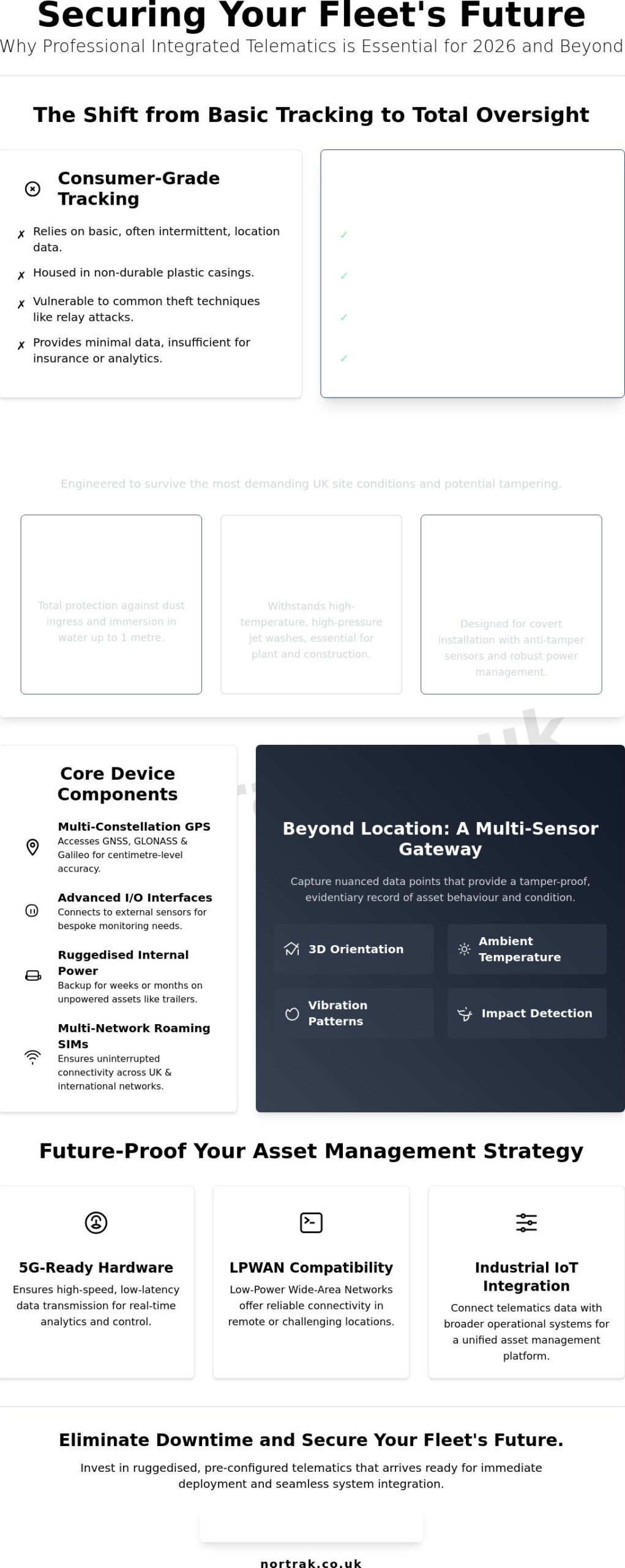
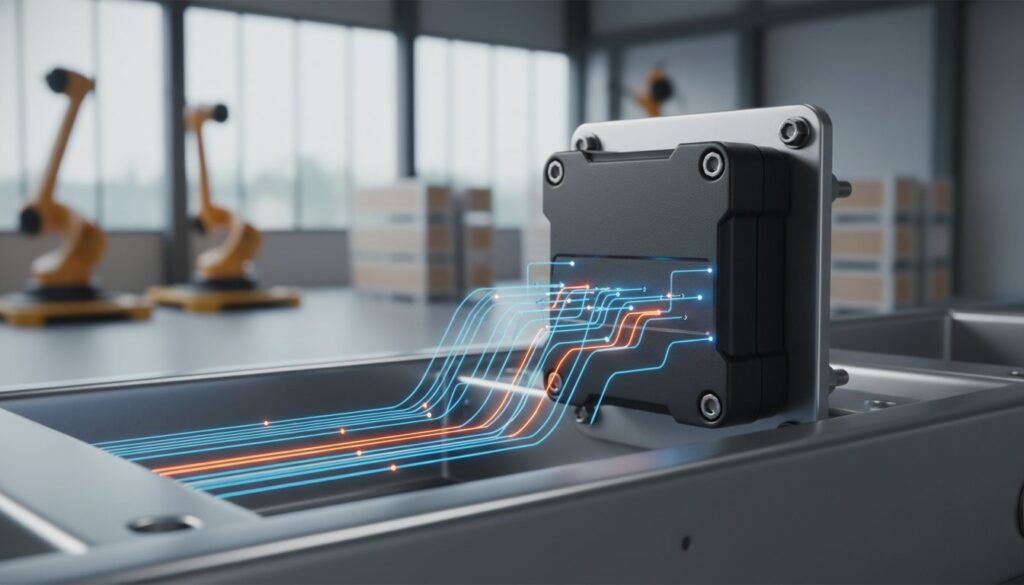
At its core, integrated Telematics hardware is far more than a simple location-pinging device. It represents the seamless fusion of multiple technologies within a single, hardened unit: high-sensitivity GPS receivers, an array of environmental sensors, and multi-network cellular connectivity. This integration transforms the device from a passive tracker into an active intelligence gateway, capturing a rich stream of data directly from the asset itself.
Unlike consumer-grade trackers designed for simple use cases, enterprise-level hardware provides the raw, high-fidelity data required for advanced AI analytics, predictive maintenance, and stringent compliance.
The Shift from Tracking to Total Oversight
The evolution of telematics is marked by a decisive shift from merely knowing an asset’s location to understanding its complete operational status. Modern hardware monitors a wide spectrum of variables, including vibration, temperature, orientation, impact forces, and engine diagnostics. This capability moves businesses from reactive tracking to proactive oversight. Integrated telematics hardware serves as a multi-sensor gateway for asset intelligence, translating physical events into actionable digital insights. This "evidentiary" data is crucial for validating insurance claims, resolving disputes, and ensuring legal and contractual compliance.
Core Components of a Professional Device
The superior performance of professional telematics hardware stems from its internal components. An analysis reveals key differentiators:
-
Advanced Receivers and Processors: Industrial-grade GPS/GNSS receivers provide positional accuracy that consumer devices cannot match, while powerful processors handle complex data processing at the edge.
-
Sensors and Interfaces: Onboard accelerometers detect motion and impact, while versatile input/output (I/O) interfaces allow for connection to external sensors like door contacts and temperature sensors.
-
Power Autonomy: High-capacity internal batteries are essential for monitoring unpowered assets, such as trailers or containers, providing reliable tracking for weeks or even months without an external power source.
-
Global Connectivity: Modern SIM technology supports resilient roaming across multiple UK and international networks, ensuring a consistent data connection wherever an asset travels.
##The Anatomy of Ruggedised Telematics Hardware
For assets operating in demanding sectors like construction, logistics, and agriculture, the physical resilience of the telematics device is non-negotiable. Ruggedised hardware is engineered to withstand harsh environmental conditions, providing consistent performance where standard electronics would quickly fail. This resilience is not an afterthought; it is a core design principle built upon stringent standards and advanced materials.
Key features include housings with high IP (Ingress Protection) ratings, such as IP67 or IP69K, which guarantee protection against dust and high-pressure water ingress. The use of robust materials like industrial-grade polycarbonate and stainless steel ensures longevity against physical impacts and corrosion. Furthermore, professional devices incorporate anti-tamper mechanisms and are designed for covert installation, making them a formidable tool in theft prevention.
Sensors and Peripheral Integration
A key strength of integrated telematics hardware is its ability to connect with an asset’s existing systems and external sensors. This creates a comprehensive monitoring network. For example, integrating with an engine’s CAN-BUS provides direct access to critical data like fuel consumption, engine hours, and fault codes. The use of Bluetooth Low Energy (BLE) enables seamless, wireless connectivity to a growing ecosystem of peripheral sensors, from tyre pressure monitors to cargo temperature probes. Specialised technologies like our Sign-bot system extend this capability, allowing for precise monitoring of specific moving parts on machinery, such as the rotation of a cement mixer drum or the operation of a crane arm.
Reliability in Extreme Conditions
Professional hardware undergoes rigorous testing to certify its performance against vibration, shock, and extreme thermal fluctuations. This is why "off-the-shelf" consumer electronics are fundamentally unsuitable for the construction and logistics sectors; they lack the durability to survive the constant vibrations of a heavy vehicle or the temperature swings of an exposed piece of plant machinery. A critical aspect of reliability is also signal penetration. Expertly engineered devices are designed to maintain GPS and cellular connectivity in signal "black spots" like dense urban areas, container ports, or large industrial zones, ensuring you never lose visibility of your assets.
##Deployment Strategies: Pre-configured vs. Bespoke Integration
One of the most significant objections to adopting professional telematics is the perceived complexity of installation. The "Downtime Dilemma"—the cost of taking valuable assets out of service for hardware fitting—is a valid concern for any operations manager. However, modern deployment strategies are designed specifically to mitigate this, offering a clear choice between rapid, scalable deployment and deep, customised integration.
The decision hinges on balancing speed with specificity. For the majority of fleets and asset portfolios, pre-configured hardware offers the fastest path to operational visibility. For businesses with unique machinery or those developing their own connected products, a bespoke OEM approach provides unparalleled customisation.
Rapid Deployment for UK Fleets
The most effective way to minimise operational disruption is with hardware that arrives ready to work out of the box. At Nortrak, we streamline the deployment process by pre-configuring devices before they are dispatched. This means each unit is already provisioned on the network, assigned to its specific asset, and loaded with any required geofences or automated alert triggers. This approach offers several technical advantages:
-
Immediate Readiness: The hardware begins tracking the moment it is powered on, eliminating on-site programming.
-
Reduced Human Error: By removing complex wiring and setup tasks from the installation process, the risk of misconfiguration is virtually eliminated.
-
Scalability: Entire fleets can be equipped in a fraction of the time it would take for traditional, engineer-led installations.
Bespoke OEM Hardware Development
For organisations with specialised industrial IoT needs or those looking to create their own connected products, a collaborative OEM (Original Equipment Manufacturer) development process is the ideal solution. This involves working directly with a hardware partner to design and manufacture a device tailored to specific requirements, from custom sensor integrations to branded, white-label housings. This path allows a business to build a proprietary asset monitoring ecosystem from the ground up, turning a standard piece of equipment into a smart, data-generating asset that provides a distinct competitive advantage.
##Securing Specialised Assets: Trailers, Plant, and Cargo
While many telematics providers focus on cars and light commercial vehicles, the greatest security challenges often lie with specialised, high-value assets. Trailers, construction plant, and international cargo require a different hardware philosophy—one centred on long-term power autonomy, extreme ruggedisation, and specific sensor integrations. Standard vehicle trackers are simply not equipped for the unique demands of these assets.
This is where purpose-built integrated telematics hardware demonstrates its true value. By designing devices for specific use cases, it becomes possible to provide a level of security and operational insight that generic solutions cannot match. A successful strategy requires a deep understanding of how these assets are used, stored, and targeted by thieves. For a comprehensive overview of how this applies to overall business strategy, explore our strategic guide for UK asset management.
TrailerSentry®: Beyond Basic Tracking
Our TrailerSentry® system exemplifies this specialised approach. Designed specifically for the vulnerabilities of unpowered logistics assets, it integrates hardware features that go far beyond simple location tracking. The device monitors for unauthorised coupling or uncoupling, providing instant alerts if a trailer is hitched at an unscheduled time or location. Integrated door sensors report every opening and closing event, creating a verifiable audit trail for cargo security. This hardware works in concert with fleet management software to provide a unified view of both powered and unpowered assets, closing a critical security gap in logistics operations.
Plant and Machinery Utilisation
For the plant hire and construction sectors, telematics hardware is a powerful tool for both security and operational efficiency. Devices can be configured to accurately record engine hours, providing indisputable proof of "hours worked" for client billing. Geographical automations are particularly effective; geofences can be used to lock equipment to a specific site, triggering an immediate alert if it is moved outside the designated zone. This, combined with our Sign-bot technology, can also prevent unauthorised use during out-of-hours periods by monitoring specific operational functions, ensuring machinery is only used by authorised personnel for its intended purpose.
##Future-Proofing with Industrial IoT and OEM Development
The field of telematics is converging with the broader Industrial Internet of Things (IIoT), where every asset, component, and piece of machinery can be connected to a central network. This shift presents a significant opportunity for businesses to gain a competitive edge. Modern integrated telematics hardware is the gateway to this connected future, equipped with the processing power and connectivity to support scalable networks of integrated sensors.
The role of edge computing is becoming increasingly important. By processing data directly on the device before transmission, modern hardware can reduce latency, lower data costs, and enable more sophisticated, real-time automated responses. This capability is essential for moving from a simple monitoring system to a truly intelligent, interconnected operational environment.
Building Connected Products
Nortrak supports businesses in making the transition from selling manual assets to offering smart, connected products. This OEM development process helps embed our tracking and sensing technology directly into a client’s own product line. OEM development facilitates powerful geographical automations for industrial use, allowing equipment to behave differently based on its precise location or operational state. This creates immense value, providing end-users with enhanced functionality and giving the manufacturer access to proprietary data that can inform future product design and service offerings.
The Nortrak Partnership Model
Choosing a telematics provider should be about more than just purchasing hardware; it should be about forming a strategic partnership. A true partner offers more than a device in a box. They provide ongoing support, expert advice on deployment, and a clear roadmap for hardware lifecycle management, ensuring your investment remains effective for years to come. Nortrak work with UK businesses to understand their unique operational challenges and deliver a hardware solution that is not just a tool, but a core component of their security and efficiency strategy.
Ready to build a resilient foundation for your asset management strategy?
Enquire about our integrated telematics hardware and OEM services today.
##Frequently Asked Questions (FAQs)
What is the difference between integrated telematics and a standard GPS tracker?
A standard GPS tracker primarily reports its location. Integrated telematics hardware is a more advanced system that combines GPS with multiple sensors (e.g., for motion, temperature, impact) and can connect to an asset’s internal systems. It provides a complete picture of an asset’s status, not just its whereabouts.
Can telematics hardware be installed on unpowered assets like trailers?
Yes. Professional hardware designed for unpowered assets contains a large-capacity internal battery, allowing it to operate autonomously for weeks or months. Specialised systems like TrailerSentry® are specifically engineered for this purpose, monitoring for theft and unauthorised use without needing a constant power source.
How does integrated hardware improve insurance claims for UK businesses?
Integrated hardware provides objective, time-stamped "evidential" data. In the event of theft or an incident, it can prove an asset’s location, report impact forces, and confirm door status. This high-quality data can help validate claims, expedite settlements, and potentially lower insurance premiums.
Is it possible to customise telematics hardware for specific industrial needs?
Absolutely. Through an OEM (Original Equipment Manufacturer) development process, hardware can be customised with specific sensors, unique firmware, and branded housings to meet the precise requirements of any industrial application or to be embedded into a company’s own products.
What is the typical lifespan of a ruggedised telematics device?
A professionally manufactured, ruggedised telematics device is built to last for many years. Its lifespan is determined by the quality of its components, its IP rating against dust and water, and its resilience to vibration and shock. Unlike consumer electronics, they are designed for the entire lifecycle of an industrial asset.
How does pre-configured hardware reduce installation downtime?
Pre-configured hardware arrives on-site already activated and assigned to a specific asset in the software platform. This "plug-and-play" approach eliminates the need for complex on-site programming or wiring, allowing for rapid installation that minimises the time an asset is out of service.
Do Nortrak devices work for international cargo and freight monitoring?
Yes. Our hardware is equipped with advanced SIM technology that supports multi-network roaming across the UK and internationally. This ensures a consistent and reliable data connection as cargo and freight cross borders, providing seamless global visibility.